

So far, we’ve been thinking about chords as things — structures you place one after another, like tiles on a floor. This chapter flips the perspective. We’re going to think about what happens between chords — how individual notes move from one chord to the next. That’s voice leading, and it’s the difference between chords that sound like a list and chords that sound like music.
What Voice Leading Is
Imagine four singers standing in a row. Each one holds a single note. Together, they make a chord. Now the chord changes. Each singer moves to a new note — but instead of leaping to a random pitch, they each move the shortest possible distance. One singer goes up a half step. Another goes down a whole step. Two of them don’t move at all.
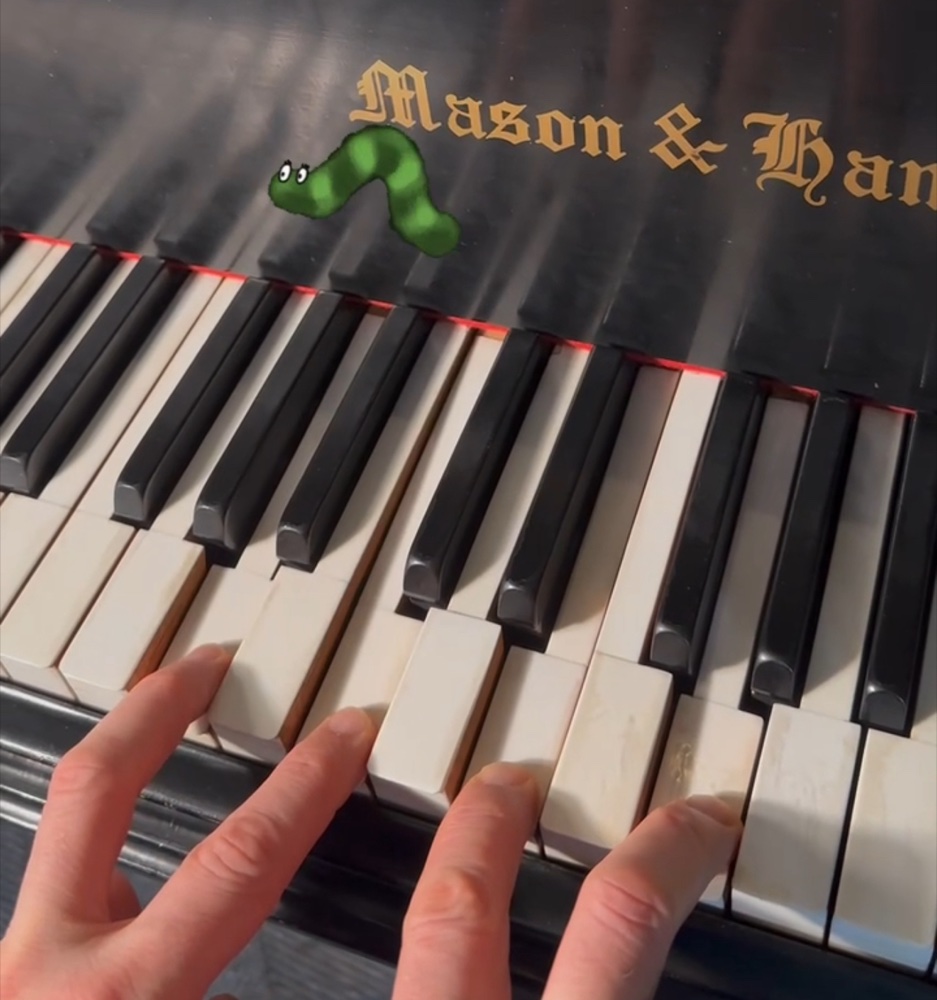
That’s voice leading. Each singer is a “voice,” and the way their notes lead from one chord to the next — smoothly, by small steps, with shared notes held in place — is what makes harmony feel connected rather than choppy.
When you play chords in root position on a keyboard — jumping from one chord shape to the next — you’re ignoring voice leading. It works, but it sounds a bit like shouting. When you rearrange the notes so that each chord shares as many common tones as possible with the one before it, and the notes that do move travel by the smallest interval — that’s voice leading. It’s judo — minimum motion, maximum effect.
Hidden Melodies
Here’s the beautiful thing about good voice leading: it creates melodies you didn’t write.
Good voice leading creates melodies you didn’t write.
— Nathan Rosenberg, Beat KitchenWhen the top note of each chord moves smoothly from one to the next, it traces a melody. When the bass moves by step, it traces another. Even the inner notes — the ones you don’t consciously hear — create little melodic threads. A well-voiced chord progression isn’t just a sequence of harmonies. It’s a web of interlocking melodies.
This is why barbershop quartets sound so stunning. Four voices, four melodies, one harmony. Each singer has a beautiful line on their own. Together, they produce chords that lock into place with an almost physical sensation — expensive-sounding, like harmony wearing a tailored suit — partly because they’re tuning to each other in real time (not equal temperament), and partly because the voice leading is immaculate.
Inversions as Voice Leading Tools
Remember inversions from Chapter 3? A C chord in root position is C–E–G. First inversion is E–G–C. Second inversion is G–C–E. Same chord, different arrangement.
Inversions aren’t just an academic concept. They’re voice leading tools. When you move from C major to F major, you could play both in root position — C–E–G, then F–A–C. That’s a jump. Or you could play C major in root position and F major in second inversion — C–E–G, then C–F–A. Now the C stays put, the E moves up one step to F, and the G moves up one step to A. Every voice moves by the smallest possible distance.
Try it on a keyboard. Play the jumpy version, then the smooth version. The difference is obvious. The smooth version breathes.
The Caterpillar Exercise
Here’s an exercise that takes everything we’ve talked about — voice leading, inversions — and wraps it into a single practice that crawls through every chord in the key.
It’s called the caterpillar. Here’s how it works.
Start with Am7 in root position — four notes: A–C–E–G. The rule is simple: alternate moving the top two notes down, then the bottom two notes down, always staying in the key of C major. Two notes move, two notes stay. That’s the whole trick.
Watch the notes trade places — two move, two stay:
Eight chords, two notes at a time, and you’re back where you started — one octave lower. That’s the full cycle. Every diatonic seventh chord in the key of C, connected by smooth voice leading.
What You Just Played
Look at the root of each chord in the cycle: A, D, G, C, F, B, E, A. Each root is the fifth of the chord that follows it. A is the fifth of D. D is the fifth of G. G is the fifth of C. All the way around.
Remember the sun and the moon from Chapter 1? From any note, reach up a fifth and you find the dominant — the sun, the strongest pull. Reach down a fifth (or up a fourth — same thing, just inverted) and you find the subdominant — the moon, always orbiting nearby.
The caterpillar walks that path in reverse. Instead of reaching up by fifths, each chord falls down by a fifth — which is the same as stepping up by a fourth. That’s why this pattern is called the circle of fourths. It’s the circle of fifths played backwards — and it’s the single most common chord motion in Western harmony. Each chord collapses into the next, a chain of events that feels almost inevitable.
The ii–V–I
Now look at three consecutive chords in the middle of the cycle: Dm7 → G7 → Cmaj7. That’s the ii–V–I — arguably the most important chord progression in jazz, and one of the most common in all tonal music.
The ii chord (Dm7) sets up tension. The V chord (G7) is the dominant — the sun pulling hard toward home. And the I chord (Cmaj7) is home. Two bars of tension, one bar of resolution. Your hands already know it from the caterpillar.
What makes G7 special here is that it’s the only chord in the cycle that’s a dominant seventh — a major triad with a minor seventh. That specific sound has a built-in restlessness. The B wants to resolve up to C. The F wants to resolve down to E. When both of those pulls land on Cmaj7, you hear it click. That click is what makes a ii–V–I feel like arriving home rather than just passing through.
The caterpillar contains the ii–V–I in every key you play it in. Learn the caterpillar, and you’ve learned the backbone of jazz harmony — you just might not have known it yet.
The Easiest Complicated Chord Progression
Here’s a party trick that comes straight out of the caterpillar.
The key of C major has a ii–V–I. So does every other key — including minor keys. The ii–V–I in A minor is Bm7♭5 → E7 → Am. The caterpillar gives you the Bm7♭5 for free (it’s right there in the cycle). To get the E7, you’d raise one note — the G becomes G#. That single alteration turns a diatonic chord into a dominant, and suddenly you’re resolving to Am with real pull.
Now take it one step further. Start on Bm7♭5 — the notes B, D, F, A. Move just the A down by a half step to G#. You get B–D–F–G# — a B diminished 7th chord that also functions as a rootless E7♭9 (the dominant of Am, minus the root). One finger moved. The chord went from “inside the key” to “pulling hard toward Am.”
That’s the easiest complicated chord progression you’ll ever play: Bm7♭5 → E7♭9 → Am. It sounds sophisticated, but the voice leading is almost nothing. Minimum motion, maximum effect.
There’s a BKS video that walks through this exact move — worth watching once you’ve got the caterpillar under your fingers.
Why This Matters
The caterpillar isn’t just a finger exercise. It teaches your hands — and your ears — what smooth voice leading feels like. After you’ve done it a few times, jumping between root-position chords will start to feel wrong. You’ll instinctively reach for the inversion that keeps the motion minimal. And that instinct is what separates a chord sequence from a piece of music.
What to Practice
- Play the caterpillar starting on
Am7. Four notes, two move at a time. Alternate top-two, bottom-two until you’re back where you started. - Once you’re comfortable, try starting on a different chord in the cycle — say,
Dm7orG7. The caterpillar works from any entry point. - Practice the
ii–V–Iin C:Dm7 → G7 → Cmaj7. Then try the minor version:Bm7♭5 → E7 → Am. - Try the “easiest complicated chord” move:
Bm7♭5, then drop one note a half step to get the diminished chord that pulls toAm. - Listen for voice leading in songs you know. Can you hear the inner notes moving between chords? The bass stepping smoothly? The top voice tracing a melody?
Search This Guide
This Course
- 1. Sound, Scales, and the Language
- 2. Your First Chords: Major, Minor, and the Dominant
- 3. The 10 Chord Toolkit: Part 1
- 4. The 10 Chord Toolkit: Part 2
- 5. Song Form and Arrangement
- 6. Ear Training: Finding Tonic, Hearing Cadences
- 7. The Four-Chord Progression and Borrowed Chords
- 8. Voice Leading and the Caterpillar
- 9. Diminished Chords, Extensions, and Other Chameleons
- 10. Rhythm: Counting, Meter, and Feel
- 11. Modes (Without the Mystique)
- 12. Blues, and the Stuff We Didn't Cover
- 13. Arrangement — Making a Track Work
- 14. Sources and Further Reading
Related Videos
Like what you're reading?
Everything in this guide is yours to keep. But reading about it isn't the same as hearing it, doing it, and having someone who's been at this for 30 years tell you why it matters in your music. This is one chapter of a live course — small group, cameras optional, taught by someone who gives a shit.
View the Theory: Musician Basics Course →© 2026 Beat Kitchen School — beatkitchen.io. Licensed under CC BY-NC-SA 4.0. Free to share and adapt for non-commercial purposes with attribution.


