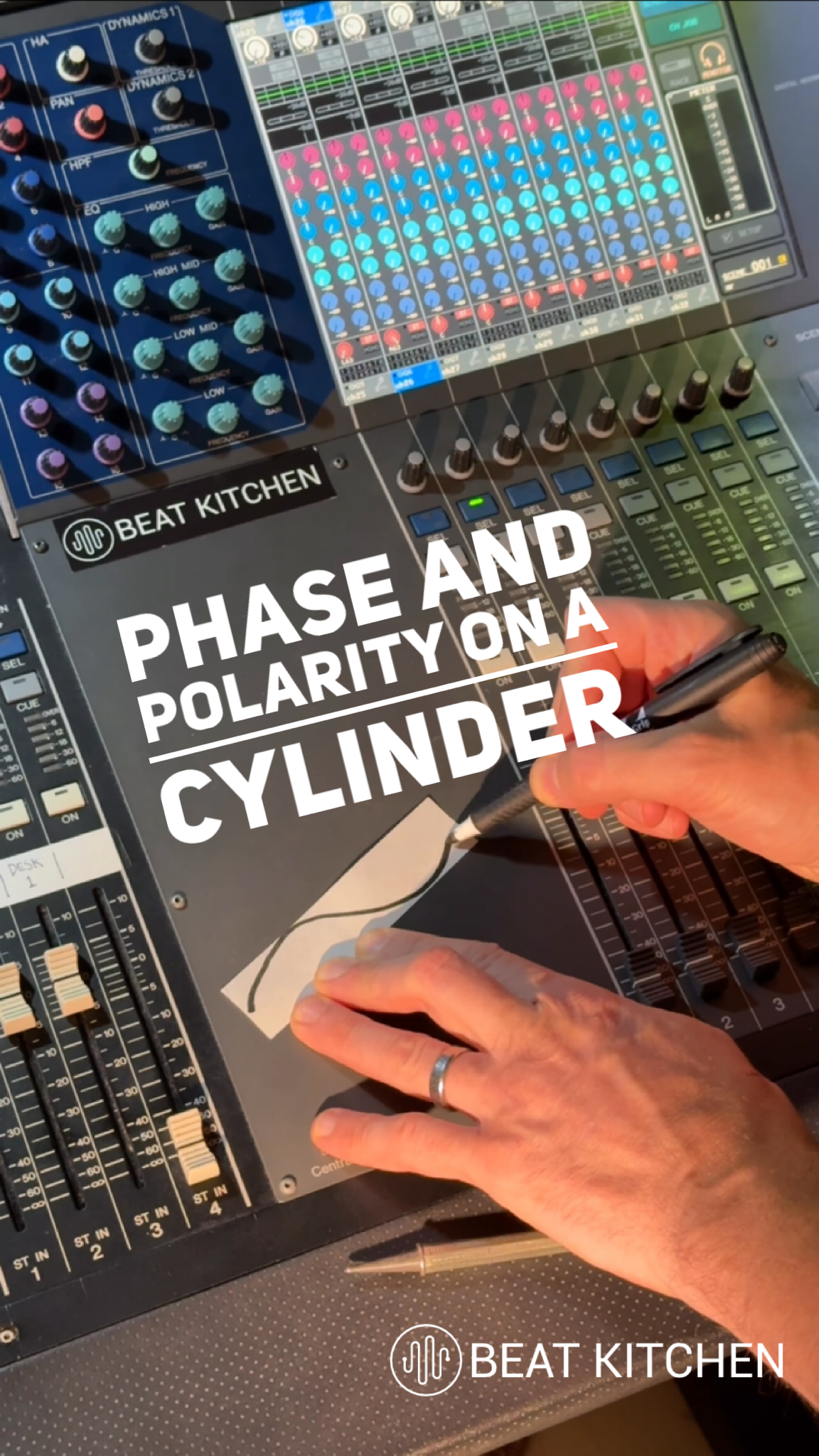
Transcription of the video above
If you go to school to become an audio engineer, one of the things they’re going to talk to you about is phase versus polarity. When we discuss phase, we’re concerned with audio as the pressure goes positive and then negative. But to understand how phase is distinct from polarity, let’s look at how phase exists on a cylinder.
A waveform is cyclical in nature, and on a cylinder we can see it. With polarity, we’re concerned with the orientation of the waveform. But with phase, we’re talking about its position. Specifically, a position on a circle, which has 360 degrees. At 180 degrees around this circle, we’ll arrive at a fixed point in the waveform, which is also a specific amount of time.
But if you’re here, you’re not recording waveforms, you’re recording music. So I want you to take a look at this. This low frequency waveform plus this high one equals this combination of both where one signal ‘rides’ on top of the other. Most sounds aren’t simple ones, they’re complex ones. So where the 360 degree phase of something like this is that, the phase of this is mapping to the distance of a single waveform.
Here you have a 180 degree phase that has a specific distance, and it also resolves above and below the center line. The distance, or the time delay, really depends on which frequency you’re measuring. So 180 degrees of this frequency is here, whereas 180 degrees of this one is there. Put them together, and the time delay for 180 degrees of this one really depends on which waveform you’re measuring. Which is totally distinct from its polarity.
What does that have to do with music? Well, a lot. But to teach it, I’ll need more than 90 seconds. So share this with someone who belongs in a Beat Kitchen class.